Over the last few years, I’ve studied the many ways self-doubt erodes the confidence of even outwardly successful people and makes it hard to pursue ambitious goals, whether personal or professional. Perhaps like me, you’ve avoided applying for a new job or submitting your work to a contest because you were convinced you weren’t sufficiently talented.
That’s a hunch, not a fact.
In response, I’ve developed tools to help all of us learn to manage our doubts and sail on past them, even if we can never banish those doubts entirely.
As a starting point, it helps to recognize some signs suggesting you may be a chronic self-doubter. For instance, if you often postpone even small decisions, like picking a new paint color for your walls, or invent reasons why “now is not the time” to act on an opportunity or make a change, you may be letting self-doubt call the shots.
Likewise, if you quickly abandon new endeavors, like, say, learning salsa dancing or studying a foreign language, you may quit while you’re ahead because you’re convinced you’re not good enough.
Understanding Self-Doubt and Its Impact
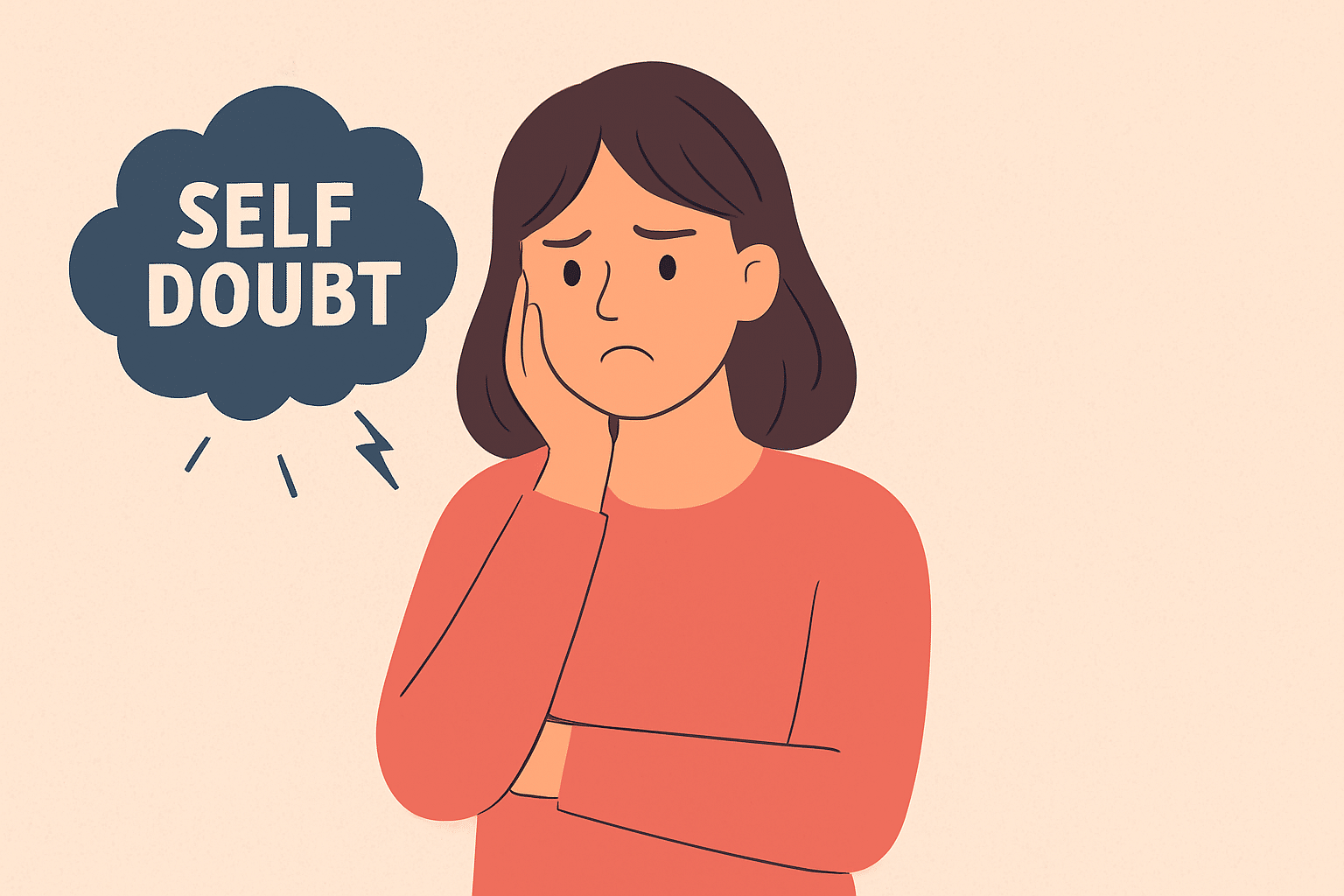
We’ve all felt that little whisper in the back of our minds that asks, “Are you sure you’re good enough?” Sometimes it’s so subtle you hardly notice it; other times it’s loud enough to stop you mid-step. Maybe you’ve stared at a blank application form, a fresh canvas, or a promising new project and thought, “Who am I kidding?” That’s self-doubt at work—sneaky, persistent, and deeply convincing.
But here’s the thing: feeling uncertain doesn’t mean you’re unqualified. In fact, it often means you’re stretching, risking, and reaching for something bigger than before. When you learn to spot that pattern and see it for what it is, you can start treating self-doubt not as a verdict but as a signpost that you’re growing.
The Mindset Challenges for Overcoming Self-Doubt That Will Change You
With a bit of determination and practice, you can modify your behavior so that self-doubt no longer has the upper hand. These five strategies will help you move the needle.
Change the channel
Your inner “doubt monsters” want the last word. But don’t let them! As the Mayo Clinic reports, “Positive thinking often starts with self-talk.” I try to put positive voices on repeat before falling asleep at night to help quiet my mind after a busy day.
I instruct my brain to stop reliving a recent rejection or a bad workshop review and dwell instead on recent successes and compliments. I focus on how those triumphs make me feel: confident and competent, and ready for more. The negative memories don’t vanish—but they’re not speaking to me all the time, either.
Gather your allies
Surround yourself with people and institutions that will back you and encourage you, supply role models, and offer practical tools to make your dream come true. For example, sidle up to friendly support or critique groups in your field. Or pursue low-cost, self-paced certificate programs that expose you to like-minded people. Activities like these help you build an encouraging network while you develop your skills in a new area.
At the same time, distance yourself from friends and family who constantly reinforce your own doubts. Your loved ones don’t want to see you fail or get hurt, so they may try to protect you by advising you not to reach for the moon. They may also question the value (and sanity) of your creative impulses, like wanting to become a freelance photographer.
You might say to them: “Thanks for your concerns. But I’m comfortable with my choice, and at this point, I need all the support and encouragement I can get. If you don’t feel able to do that, then it’s fine with me if we don’t discuss this any further.”
Renegotiate your relationship to risk and reward.
Our culture prizes efficiency and productivity. Call it “hustle culture,” where you’re expected to always be racing to the next project, the next deadline. But when you embark on projects where there’s no quick win, no way to hustle to a result, that’s when doubt kicks in. You wonder: What if I’m doing this all wrong?
Tackle that negative thought by giving yourself permission to accept that intensely creative new endeavors come with risk, and risk brings uncertainty. That’s the territory—and it’s not on the hustle-culture track. Allow yourself to experiment without deadlines and treat failures as free learning opportunities.
After all, whether you’re a writer, an entrepreneur, or practicing to swim the English Chanel, success does not arrive all at once, and not always on a pre-arranged timetable, either. Big swings are risky by definition, as they suck up our time, energy, and focus. Don’t doubt your ability to succeed because time is passing and you have little or nothing to show for your efforts.
Contrary to conventional wisdom, it’s okay to focus on the destination and not on the journey, which is bound to be bumpy.
Focus on your ‘why’
Whether you’re a major league athlete or the founder of a start-up, you’re going all-in on something you love and that lights you up. Your ‘why’ holds the key to driving your passion forward. Hold onto your ‘why’ when doubts surface. Try keeping a journal in which you note your reasons for doing things that matter to you. Why are you willing to take creative risks? Why do you want to make meaningful changes in your life? And why are you deeply interested in and moved by the work you do—or want to do?
As the German psychiatrist Viktor Frankl wrote in Man’s Search for Meaning, “He who has a ‘why’ to live can bear with almost any ‘how.’”
Put your doubts to good use.
Doubt can be a force for good. Think of the surgeon who pauses before cutting into a patient’s leg to be sure they’re tackling the correct limb! Your doubts are not telling you “no,” but rather where to sharpen and apply your skill, talent, and intellect. This is a classic “yes and” strategy: acknowledging doubt’s downside while harnessing its upside.
As award-winning author Maggie Jackson notes in her book, Uncertain: The Wisdom and Wonder of Being Unsure, “Uncertainty plays an essential role in higher-order thinking, propelling people in challenging times toward good judgment, flexibility, mutual understanding, and heights of creativity.” Doubt is friend as well as foe.
In short, we cannot banish all our doubts, but we can adopt conscious attitudes to help us manage doubts as they arise and learn to work with them so that they don’t dominate or control our actions, force us to come to a grinding halt, or, most importantly, kill our wildest dreams.

Amy L. Bernstein is an award-winning author and journalist. Her latest book is Wrangling the Doubt Monster: Fighting Fears, Finding Inspiration. She’s also a certified nonfiction book coach and leads workshops around the country on writing and creativity. Learn more.
- Amy Bernstein