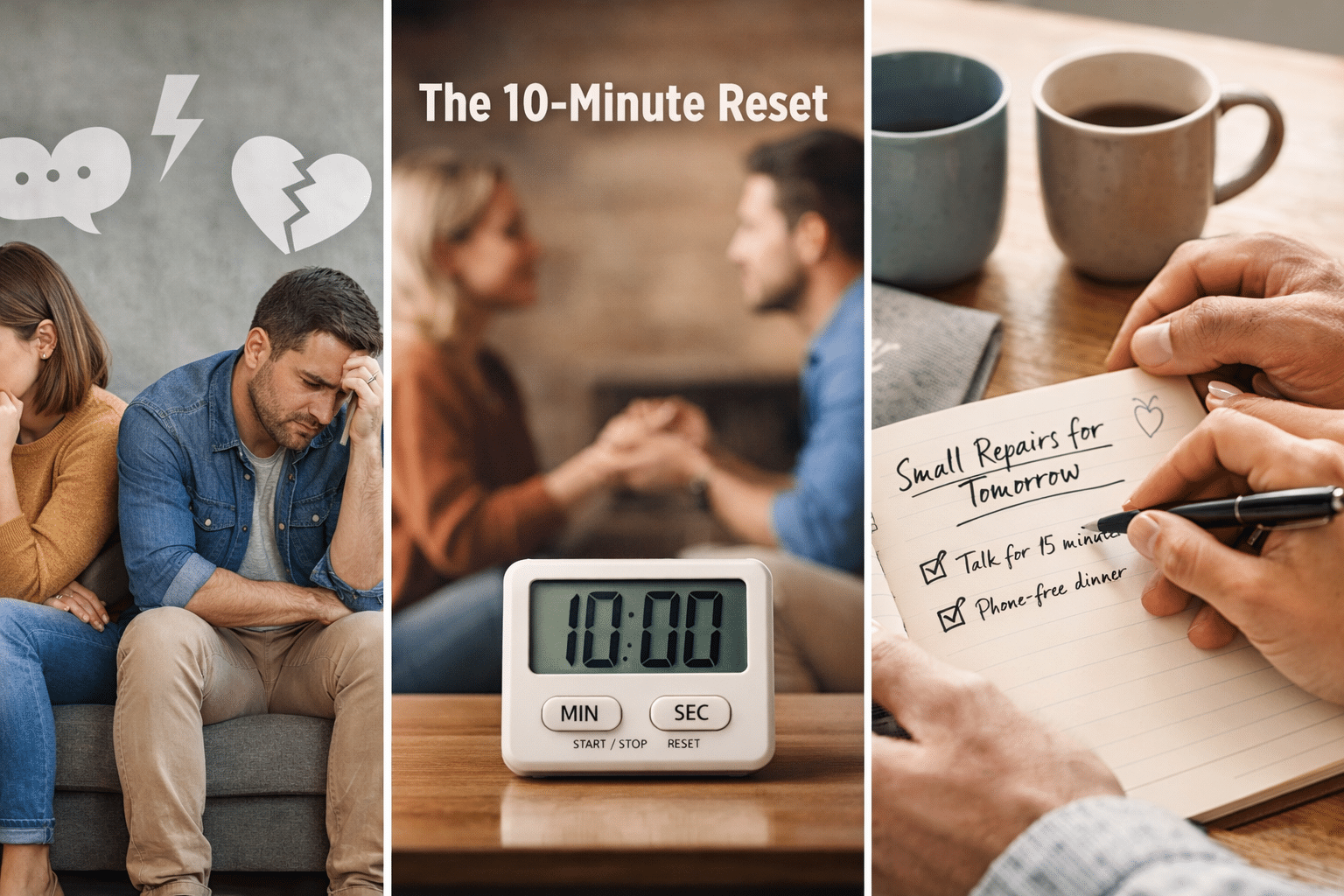
Have you ever watched a perfectly normal day turn into a full-blown fight over something small, like dishes in the sink or a “tone” that felt off? One minute it’s about a tiny moment, and the next minute you’re replaying old wounds, questioning intentions, and wondering how you got here again.
That doesn’t mean you’re bad at relationships. It usually means you don’t have a reliable way to interrupt the conflict spiral once it starts.
In my work as a marriage advisor, I see the same pattern across different couples, personalities, and life seasons. Most people do not fall out of love in one dramatic event. They drift. They drift through misunderstandings that never get clarified, needs that never get spoken, and repeated reactions that never get repaired. The encouraging part is this: the fix often is not a huge breakthrough. It is a small, consistent reset that prevents resentment from stacking up.
This article gives you a practical framework you can use in real life, even when you are busy, tired, or not in the mood to talk.
Why relationships break down (in plain language)
Most couples struggle for three main reasons.
1) They react faster than they reflect
Stress hits, you feel criticized, and you respond quickly. Your partner responds quickly too. Before either of you has processed what is really happening, you are defending your dignity instead of protecting the relationship. In that state, even loving people can say harsh things.
2) They speak in accusations instead of needs
A sentence like “You never help” usually hides something softer and more vulnerable, like “I feel alone” or “I am overwhelmed.” Accusations trigger defensiveness. Needs invite understanding, even if the other person does not agree right away.
3) They wait too long to repair
Many couples believe they will talk when they are calm. The problem is that calm rarely arrives by itself. Work continues, kids need attention, life stays loud, and the unresolved tension becomes the new normal. Small disappointments become a quiet backlog.
The goal is not to never argue. The goal is to repair quickly and consistently.
A common concern: “Isn’t this just lowering standards?”
Some people hear the word “repair” and assume it means tolerating bad behavior. It does not.
Repair is not:
- Excusing disrespect
- Staying silent to keep the peace
- Pretending you are okay when you are not
Repair is what happens after you name the standard. It is how you return to respect and closeness without letting pride run the show.
Also, a clear boundary matters here. If your relationship involves abuse, coercion, or intimidation, the solution is not better communication. The priority is safety and professional help.
In these situations, it can help to speak with a divorce lawyer. These professionals can help you understand issues like custody and support, and the legal steps involved in leaving a relationship. Sometimes a reset won’t work, especially if one partner has been unwilling to make changes. Before moving ahead with any radical solution to your relationship problems, it makes sense to learn about all of your options and find out how you can leave safely.
For normal conflict between two imperfect people, repair is the difference between growth and slow decay.
The 10-Minute Marriage Reset (a simple daily practice)
Pick a time that is realistic. After dinner, before bed, during a walk, or even in the car. Set a timer for 10 minutes. Keep it short on purpose, because consistency beats intensity.
The rules
- No problem-solving in the first part of the conversation
- No interrogations
- No bringing in the entire history of the relationship
- You are not trying to win. You are trying to reconnect
Think of it like brushing your teeth. You are not doing it because you have a dental emergency. You are doing it because it prevents one.
Minute-by-minute structure
Minutes 1 to 3: “What went well today?”
This can feel cheesy, but it is not. You are training your attention to notice effort and contribution, not only mistakes.
Examples:
- “I appreciated you taking that call so I could rest.”
- “Thank you for being patient with me this morning.”
- “I liked how we handled the kids’ routine.”
Keep it simple. One or two sentences is enough.
Minutes 4 to 7: “What felt hard, and what do you need?”
This is where couples usually slip. They state the complaint, but they skip the need.
Instead of:
“You were rude.”
Try:
“When you spoke sharply, I felt dismissed. I need a calmer tone, especially when we’re stressed.”
If you do not know your need yet, start with one of these:
- “I think I need reassurance.”
- “I think I need teamwork.”
- “I think I need respect.”
- “I think I need quiet.”
- “I think I need affection.”
This is also the moment to keep your words clean. Focus on one issue, not five. If you have ten things to discuss, choose the one that matters most today and save the rest.
Minutes 8 to 10: “One small repair for tomorrow”
Make it tiny and specific. A repair is an action that reduces friction or increases connection.
Examples:
- “Can we do a five-minute tidy together after dinner?”
- “If I’m getting heated, I’ll take a ten-minute break and then come back.”
- “Can you hug me when you get home before we start talking logistics?”
- “Can we put phones away for the first fifteen minutes after the kids go down?”
This is how you prevent “We never talk” from turning into “We’re basically roommates.”
The Spiral to Repair switch you can use mid-argument
When conflict escalates, your job is not to deliver the perfect speech. Your job is to interrupt autopilot.
Use this simple four-step switch:
Pause
Stop feeding the fire. Take a breath. Lower your volume.
Name what’s happening inside you
Try: “I’m getting defensive,” or “I’m hurt,” or “I’m overwhelmed.”
Ask clearly
Try: “Can we slow down? I want to understand, not fight.”
Repair with one sentence that lowers threat
Try: “I’m on your side,” or “I care about us,” or “I don’t want to hurt you.”
That last line matters more than people admit. Many fights are fear in disguise. Fear of not being valued. Fear of being controlled. Fear of being alone.
A real-life example
Scenario: One partner says, “You’re always on your phone.”
Typical response:
“I work all day, leave me alone.”
A repair response might sound like:
- “You’re right that I’ve been distracted.”
- “I’m not trying to ignore you.”
- “Can we do fifteen minutes together first, and then I’ll finish this?”
Is that giving in? No. It is leadership. It keeps the issue small and solvable instead of turning it into a character trial.
What to do when your partner won’t participate
This is common. One person wants change and the other is skeptical, tired, or afraid that talking will lead to conflict.
Start anyway, but do it without making it a lecture.
Try these approaches:
- Do the 10-minute reset solo as a short journal practice, then share one sentence.
- Offer appreciation first. Appreciation lowers resistance.
- Make one clear request, not a long speech. For example: “Can we try this for seven days and keep it short?”
- Keep your tone calm. If it feels like a trap, they will avoid it.
Consistency creates safety. Safety creates willingness.
And if you’re thinking, “Why should I be the one to start?” here’s the truth: waiting for perfect fairness is one of the fastest ways couples stay stuck for years.
Common mistakes that make this harder than it needs to be
If you try this and it feels like it “doesn’t work,” check these first:
- You turned the reset into a debate
Remember, the goal is connection first. Solutions come later. - You spoke in global statements
Avoid “always,” “never,” and “you are.” Stick to “when this happened, I felt this.” - You brought in old history
The reset is about today. If something older needs attention, schedule a separate conversation. - You asked for a huge change
Small repairs build trust. Big demands trigger fear.
The bottom line
Relationships do not need more dramatic talks. They need better daily habits.
If you can do three things, you will be ahead of most couples:
- Interrupt the spiral early
- Speak needs instead of accusations
- Repair in small, consistent ways
That is how love stays practical, not just sentimental.

Paul Friedman is the Director and Founder of The Marriage Foundation, driven by a simple belief: strong marriages change lives. He’s dedicated to helping couples find their way back to each other with practical, research-informed guidance through marriage courses. Paul’s work focuses on rebuilding trust, improving communication, and creating steadier homes, because when a relationship gets healthier, everything around it tends to follow.