Starting a business is exhilarating—but it’s also a journey filled with unexpected obstacles. Even the most determined entrepreneurs encounter roadblocks that can slow growth, strain resources, and test resilience. From choosing the options to start a business to building trust and finding clients to mastering pricing and scaling systems, the challenges when starting a business are real—and often unavoidable.
In this article, we’ve gathered insights from 18 founders across industries who faced these challenges head-on. Each shares their personal experiences, highlighting the struggles that nearly every entrepreneur encounters, and the lessons that helped them move forward.
Instead of generic advice, you’ll get real stories from people who built businesses from scratch, revealing patterns that anyone starting out can learn from. Whether you’re launching your first venture or scaling an existing one, these examples offer practical motivation & inspiration, actionable strategies, and a glimpse into the mindset that separates successful founders from the rest.
To make it easier to digest, we’ve organized the challenges into key areas, summarized patterns across founders, and included tables to highlight actionable insights. By the end of this article, you’ll not only understand the hurdles you might face—but also how to approach them strategically, step by step.
Overview: Challenges When Starting a Business
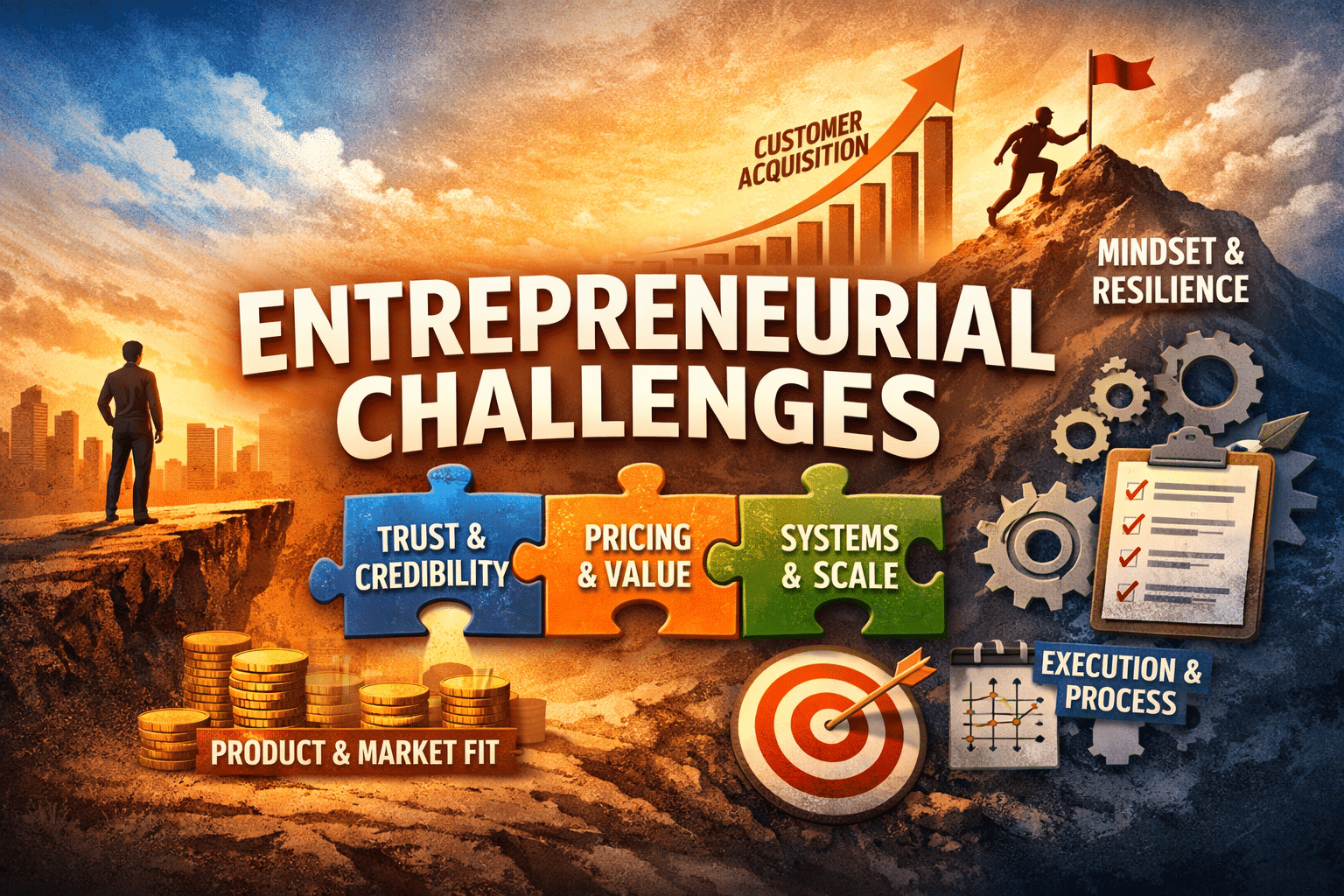
| Core Challenge Area | Common Struggle for Founders | Why It’s Difficult Early On |
|---|---|---|
| Trust & Credibility | Building reputation before anyone knows you | No track record or social proof, making early clients hesitant |
| Pricing & Value | Charging appropriately for services or products | Fear of losing clients, underestimating worth, or competing on price |
| Systems & Scale | Doing everything yourself and managing growth | Control feels safer than delegation, creating bottlenecks |
| Customer Acquisition & Conversion | Attracting clients and converting traffic into paying customers | Limited marketing knowledge and unproven channels can stall growth |
| Founder Mindset & Resilience | Coping with setbacks, uncertainty, and self-doubt | Emotional fatigue and lack of experience can undermine decisions |
| Product & Market Fit | Prioritizing features and refining offerings | Trying to do too much too soon can dilute focus and slow progress |
| Culture & Team | Building the right team and maintaining company culture | Finding specialists and fostering collaboration is challenging early on |
Trust & Credibility
Trust is often the first and biggest hurdle for new businesses. Without a track record, founders must demonstrate integrity, transparency, and reliability before clients will engage. How you earn trust sets the foundation for every other aspect of growth, from pricing to referrals.
Below are real stories from founders who navigated this challenge successfully:

Earn Trust through Radical Transparency
The biggest challenge I faced when starting my business was earning trust before I had a reputation. I knew the water, I knew marine biology, and I knew I could give families an incredible experience, but in the beginning, no one knew who I was. In a tourist town, that is a real hurdle. Families are careful about who they book with, especially when kids are involved.
I overcame that by leaning fully into transparency and education. I did not try to be the flashiest option. Instead, I focused on being the most informative and approachable. I shared what I knew about the local wildlife, explained how our tours worked, and showed real moments on the water instead of polished marketing. I talked to every guest like they were already part of the adventure.
Word of mouth carried everything forward. Once families started leaving reviews and telling their friends, momentum built naturally. I learned that trust is earned one great experience at a time, and if you focus on doing the right thing consistently, growth follows.

Honor Culture and Broaden Access
Robert Dunfey, Founder, GoSkate.com
When I started my company, the biggest challenge wasn’t money, competition, or even growth. It was trust.
Skateboarding doesn’t come from a classroom. It comes from cracked pavement, empty schoolyards, and friends teaching friends. So when I first had the idea of building a structured skateboard school, a lot of people looked at me like I was missing the point. I remember someone saying, “You can’t teach skateboarding — you either live it or… you don’t.”
And honestly, I understood that fear. Skateboarding is personal. It’s rebellion, creativity, and community all wrapped into one board. Turning that into a “business” felt risky, even to me.
In the early days, the hardest part was convincing skaters that we weren’t here to water it down or turn it into some corporate version of skateboarding. Parents wanted safety. Skaters wanted freedom. And I was standing in the middle, trying to respect both.
What changed everything was going back to the skatepark.
I stopped pitching. I started listening. I watched how skaters naturally taught each other — one tip at a time, one push at a time. “Try moving your front foot just a little,” or “Don’t rush it — feel the board first.” That became our foundation.
We built the business around real skaters teaching real people, at real skateparks. No scripts. No fake hype. Just guidance, encouragement, and patience. We focused on progression, not perfection. It is our mission.
The moment I knew we were onto something was when a kid finished his first lesson and said, “This feels like skating with someone who actually gets it.” That’s when trust started to grow.
The biggest challenge wasn’t building a company — it was protecting the soul of skateboarding while helping more people access it. We overcame it by staying close to the culture, listening more than talking, and never forgetting why we stepped on a board in the first place.
Skateboarding gave me everything. This company was my way of giving something back — without losing what made it special.

Deliver Exceptional Care to Spark Referrals
Ramona Jar, Founder and CEO, Ablyo
I have started my business at least 3 times (initially, after immigrating, and now as a SaaS founder), and what moved the needle was excellent customer support. In our case, since I’ve always ran small business, being personable and treating our clients like family has led to a whopping 99% referral rate. All our clients come from word of mouth, which has allowed for huge marketing savings. For an SEO-based business, not having to pay for advertising is huge. Finding the initial clients is not easy, but all you need is 1. Overdeliver and then grow from there.
Trust & Credibility Table
| Founder Insight Theme | What This Looks Like in Practice |
|---|---|
| Radical transparency | Sharing real process, being approachable, educating clients |
| Cultural respect | Staying true to your niche or community without compromising values |
| Overdelivery & care | Treating clients like family, going above expectations to earn referrals |
Pricing & Value
Pricing is not just about numbers—it’s a reflection of your confidence, your perceived value, and the outcomes you deliver. Many founders struggle with undercharging early on, trying to win clients, or responding to pressure to compete on price.
The stories below highlight how real founders overcame these challenges by reframing value, setting clear processes, and charging for outcomes rather than approval.
Price by Value and Establish Process
Sahil Agrawal, Founder, Head of Marketing, Qubit Capital
The hardest part was charging the right amount before we had proof that we deserved it.
At the start, you say yes to everything. Lower rates. Rush requests. Clients who want ten things but only want to pay for three. It feels like progress, but it quietly drains you.
What changed things was building a process before hiring anyone. We stopped pricing by the hour and started pricing around outcomes. Almost instantly, the type of clients we attracted shifted. The workload stayed similar, but margins improved and weeks felt calmer. That shift made everything else possible.

Charge for Outcomes Not Approval
Ken Marshall, Co-Founder, Meet Sona
Not knowing my worth. I charged $800 for websites and worked at 5% profit margins because I thought that’s what it took to win clients. When I raised prices to cover my first hire, clients pushed back.
Underpricing doesn’t build trust; it communicates you don’t believe in your own value. I overcame it by stopping the race to the bottom. I started charging what the work was actually worth based on business outcomes, not what I thought people would pay. Lost some clients. Gained better ones.
Now I work with people who understand value, not just cost. You have to know your worth before you can step into it. That confidence shift was a ridiculously valuable unlock.
Pricing & Value Table
| Challenge | What Founders Did Differently | Key Takeaway |
|---|---|---|
| Charging too little / low confidence | Shifted from hourly to outcome-based pricing | Clients attracted based on value, not cost |
| Saying yes to everything | Built processes before hiring, prioritized profitable clients | Workload managed efficiently, margins improved |
| Fear of losing clients | Raised prices to reflect true worth | Some clients lost, better clients gained |
Systems & Scale
One of the biggest growth bottlenecks for founders is trying to do everything themselves. Early-stage entrepreneurs often feel safer staying involved in every decision, but this approach limits scale and slows progress.
The stories below show how founders overcame this by trusting systems, delegating tasks, and building specialist teams, ultimately unlocking growth and efficiency.
Adopt Systems to Unlock Scale
Todd Anderson, Owner, Lodestar Talent
The biggest challenge at the start was learning to trust systems instead of trying to do everything myself. Early on, it felt safer to stay involved in every decision, but that quickly became a bottleneck and slowed progress. Growth was limited not by opportunity, but by how much I could personally handle.
The turning point came from stepping back and building repeatable processes that others could follow. Letting go of control was uncomfortable, but it created space for the business to scale and for better decisions to happen faster. The experience taught me that momentum comes from structure, not hustle alone.

Delegate Wisely and Triage Tasks
Soumya Mahapatra, CEO, Essenvia
I would say organization was one of the biggest challenges for me personally. Starting a business is a pretty huge organizational challenge, when you’re juggling a business plan, finances and accounting, hiring staff, etc., and while I was prepared for some of it, it pretty quickly became overwhelming. What I found most helpful in overcoming it was just delegating and hiring professionals where necessary to take on some of the burden, especially when it came to finances. I also found that “triaging” tasks was helpful because it allowed me to tackle things one at a time instead of trying to do everything at once.

Build Specialist Teams and Reward Excellence
Lumen Leon, Rédacteur Principal, Mag Startup
I launched a tech company without writing a single line of code. No technical co-founder. Classic recipe for disaster.
I discovered the magnitude of this problem after I’d already burned significant capital. Before starting, I genuinely believed marketing would be the hard part. I was spectacularly wrong.
My solution was counterintuitive: I stopped looking for a technical co-founder entirely. Instead, I built a team of specialists — not generalists. No full-stack developers. Pure experts: backend, frontend, database, DevOps. Each one owning their domain.
My hiring approach raised eyebrows: I asked salary expectations upfront. If the number fit my budget, I said yes immediately. No negotiation theater. “You want X? Done. I expect X-level output.” This attracted confident professionals who knew their worth — and delivered.
One engineer consistently outperformed. I promoted him to Tech Lead and structured a 3+ year equity vesting plan. He went from employee to co-owner overnight.
The lesson: A missing technical co-founder isn’t a death sentence. It’s a hiring problem. Pay market rates. Skip the negotiation games. Convert your best performer into a stakeholder.
That early “weakness” became our competitive advantage.
Systems & Scale Table
| Challenge | How Founders Solved It | Key Takeaway |
|---|---|---|
| Bottleneck from doing everything themselves | Built repeatable processes that others could follow | Growth is limited by systems, not opportunity |
| Overwhelm from managing multiple priorities | Delegated to professionals and triaged tasks | Focused on what only they could do; reduced stress |
| Lack of technical or specialized expertise | Hired specialists and rewarded excellence with equity | A missing co-founder isn’t a death sentence; the right team enables scale |
Customer Acquisition & Conversion
Attracting customers and converting them into loyal clients is one of the most immediate challenges for any new business. Many founders struggle with knowing where to find clients, how to optimize conversions, and how to stand out in competitive markets.
The stories below show how founders overcame these challenges with strategic research, relentless quality, and disciplined planning.

Research Client Acquisition Methods
Matthew Davis, Business Lawyer & Firm Owner, Davis Business Law
I had a solo law practice in my hometown, which is 85 miles outside of Oklahoma City. Eleven years ago, I decided to turn it into a business and start growing it in OKC. I did not know how to get clients outside of word of mouth but started researching marketing. I spent an enormous amount of time reading and asking questions of successful firms. I wish YouTube had the content it does now back then. As we continue to grow now to our tenth market, I find it an invaluable tool to keep up on marketing trends.
Plan Conversions with Budget Rigor
Jordan McCaleb, Founder, Goldpedia
The biggest challenge was spending heavily on ads that drove visitors but without a clear plan to convert them. I corrected course by setting a disciplined budget, building a concrete conversion plan for that traffic, and putting backup plans in place to absorb financial hits.

Outshine Rivals through Relentless Quality
Silvia Lupone, Owner, Stingray Villa
Our biggest challenge was competition. We faced over 2,500 other Airbnb rentals just on the island of Cozumel. We knew we could not be the cheapest, so we chose to be the best.
We focused intensely on quality. We studied all the experts’ recommendations on how to take great pictures, optimize our listings, and write the best copy to attract people who only skim. Our website had to be perfectly laid out to make booking easy. By excelling at those small details, we rose above the noise and made our listings stand out.
Customer Acquisition & Conversion Table
| Challenge | What Founders Did Differently | Key Takeaway |
|---|---|---|
| Limited marketing knowledge | Researched successful strategies, followed trends, asked experts | Educate yourself before spending on acquisition |
| High ad spend without conversions | Set disciplined budgets and created concrete conversion plans | Traffic alone doesn’t equal growth; conversion planning is essential |
| Competitive market | Focused on exceptional quality and attention to detail | Standing out is about doing better, not cheaper |
Founder Mindset & Resilience
Even with the best systems, clients, and products, founders face one universal challenge: the mental and emotional demands of entrepreneurship. Handling setbacks, maintaining belief, and staying committed in the face of uncertainty often determines whether a business survives or thrives.
The stories below show how founders navigated these internal challenges by resetting after losses, accumulating small wins, embracing uncertainty, and cultivating audacious vision.

Master Resets after Every Setback
Vladica Lapcevic, Co-Founder, Codevelo
The biggest challenge when I started my business was honestly me.
Not lack of ideas, not competition — it was how I handled things when they didn’t go my way. There were a lot of moments that felt like straight-up losses. Deals that fell through, weeks where nothing worked, situations that felt impossible to recover from. What made it hard wasn’t the situation itself, but what was going on in my head afterward.
At some point, I realized I had two options after every setback: let it spiral, or reset and keep moving. I started thinking about it the way tennis players do. You lose a point — sometimes badly — but you don’t get to stay there. You take a breath, talk to yourself, and focus on the next serve. That idea helped a lot.
Positive self-talk wasn’t about hyping myself up. It was more like saying, “Okay, that happened. What’s the next small thing I can do?” Over time, every situation that felt like a loss became fuel — not immediately, but eventually. That’s what kept me going when things felt heavy.
Looking back, learning how to recover mentally was more important than any business skill. Without that, the journey would’ve stopped early.

Believe Deeply and Accumulate Small Wins
Jamie Maltabes, Founder, Infinite Medical Group
The biggest challenge I faced when founding my company was trusting in the unknown. I had to learn to believe that I could do it. I didn’t need to be the smartest, or the richest; I just needed to keep working at it day after day. I had to make thousands of decisions with no clear answer and trust my gut A LOT. Over time I started stacking small wins and began to understand that I could do anything I put my mind to — and if I don’t know how — I can find someone who does.

Embrace Uncertainty One Step at a Time
Wan Ting Tan, Owner, SpringBoard
Even with thorough preparation and a deep understanding of every component, there is still a lingering sense of the unknown for operating the business. To overcome it, I learned to push through one step at a time. You can’t predict what will go wrong; you can only react to it.
For me, the biggest advice I have for anyone trying to their first business and so on, learning to be comfortable with surprises is essential, whether they turn out to be challenges or opportunities.

Cultivate Audacious Vision via Daily Practice
Dean Whitby, Founder & MD, Tenacious Sales (Operating internationally as Tenacious AI Marketing Global)
The biggest challenge was the ability to dream big, bigger than my past and current mind could think. I solved that by doing years of work on reprogramming my subconscious mind using meditation before sleep and every morning, by upskilling and learning every day for years, and I’ve reached a stage where my dream is bigger than those around me can possibly even think about, and even my team get amazed by how big we dream.
Founder Mindset & Resilience Table
| Challenge | How Founders Overcame It | Key Takeaway |
|---|---|---|
| Setbacks and failures | Adopted a “reset” mindset and focused on next steps | Recovery speed matters more than the setback itself |
| Self-doubt and uncertainty | Accumulated small wins to build confidence | Small, consistent progress reinforces belief in ability |
| Fear of the unknown | Took one step at a time, embracing surprises | Comfort with uncertainty enables informed risk-taking |
| Limiting vision | Reprogrammed mindset, meditated, upskilled daily | Dreaming bigger expands what’s possible for the business |
Product, Process & Execution
Building a business isn’t just about trust, pricing, or mindset — it’s also about execution. Founders face challenges in sourcing reliable materials, making fast decisions with limited information, and prioritizing features effectively. How you structure your operations and product development can determine whether your business thrives or stalls.
The stories below highlight how founders tackled practical execution challenges while maintaining quality and progress.

Source Sustainably and Validate Material Integrity
Brinda Ayer, Environment and Development Consultant, Founder and Principal Consultant, Urban Creative
The biggest challenge in starting my business was finding reliable, truly sustainable materials that met design standards. Early on, only about 40% of sourced materials met both environmental and quality expectations, causing delays and limiting product options. Over time, building strong relationships with local suppliers and carefully testing each material increased that success rate to nearly 85%. This shift not only improved product consistency but also strengthened trust with customers who valued authenticity. Observing this process showed that patience, hands-on evaluation, and alignment with local partners are crucial when pursuing sustainability in business. Other leaders can see that investing time in understanding the supply chain, rather than rushing production, produces tangible results and builds credibility. The evidence came directly from tracking material quality and customer satisfaction, demonstrating that thoughtful, persistent effort transforms challenges into measurable progress.

Make Fast Decisions and Iterate
Julia Rueschemeyer, Attorney, Attorney Julia Rueschemeyer Divorce Mediation
The biggest challenge when I started my own divorce law business was the fact that I had to figure out everything: an office location, marketing, phone numbers, a website, document preparation software, and billing and accounting systems. How I overcame the enormity of this was a) doing some research on each issue then making decisions quickly and efficiently, b) realizing that Rome was not built in a day, and c) staying agile so that I could upgrade systems — whether marketing, phone answering, or record keeping and accounting — as the business grew. I made sure I started getting some income right away, but it was not pretty. I got my first divorce client through word of mouth and then met with him in a deli, because I didn’t have an office, and scrawled handwritten notes on a legal pad. I built the business iteratively: a better website led to more business, so I needed more efficient intake systems and document processing. I created custom software to create legal documents from client inputs, moving labor from my business onto clients even as I raised prices. When the volume of customers got too big, I hired first administrative help and eventually more lawyers.

Prioritize Essential Features
Jamie Frew, CEO, Carepatron
Our biggest challenge in the early days was trying to tackle too many things at once. We corrected course by prioritizing the most important features, making necessary trade-offs without losing sight of our vision, and pacing our growth. That discipline kept the team focused and moved the product forward.
Product, Process & Execution Table
| Challenge | How Founders Solved It | Key Takeaway |
|---|---|---|
| Finding reliable, sustainable materials | Built strong supplier relationships, tested each material carefully | Patience and hands-on evaluation improve consistency and credibility |
| Handling multiple unknowns simultaneously | Researched, made decisions quickly, iterated systems | Fast, informed decisions accelerate early-stage progress |
| Tackling too many tasks at once | Prioritized essential features, made trade-offs | Focused execution keeps teams aligned and product moving forward |
Pattern Across 18 Founders
The 18 founders highlighted in this article faced a wide range of challenges — from building trust and sourcing materials to pricing, systems, client acquisition, and personal resilience. While the industries and specifics varied, the patterns were strikingly consistent.
Entrepreneurs who succeed don’t necessarily avoid challenges—they navigate them with intention, discipline, and adaptability. By learning from these founders, you can anticipate common hurdles, adopt proven strategies, and develop the mindset and systems to thrive.
| Pattern Across Founders | What It Means for Entrepreneurs |
|---|---|
| Trust comes before growth | Focus on building credibility, cultural alignment, and exceptional client experiences before scaling. |
| Pricing reflects belief | Charge for value and outcomes, not approval; underpricing signals low confidence. |
| Systems unlock freedom | Create repeatable processes, delegate effectively, and empower specialists to scale efficiently. |
| Conversion requires planning | Traffic and leads alone aren’t enough; a disciplined plan converts interest into revenue. |
| Execution drives progress | Prioritize essential features, make fast informed decisions, and test iteratively to keep moving forward. |
| Mindset is an operating system | Recover from setbacks, embrace uncertainty, accumulate small wins, and cultivate a bold vision. |
| Culture and care compound | Respect your community, maintain company culture, and overdeliver to spark referrals and loyalty. |

Amit is a lifelong learner and advocate for personal growth, fueled by 15+ years in HR across various functions. His journey includes a dual Master's degree: an MBA specializing in HR and Information Technology, and another Masters dedicated to HR Management & career development. This blend of knowledge allows him to translate personal development strategies into actionable steps. Whether you're seeking career advancement or simply becoming your best self, Amit is here to share insights, tips, and inspiration to help you unlock your full potential.